
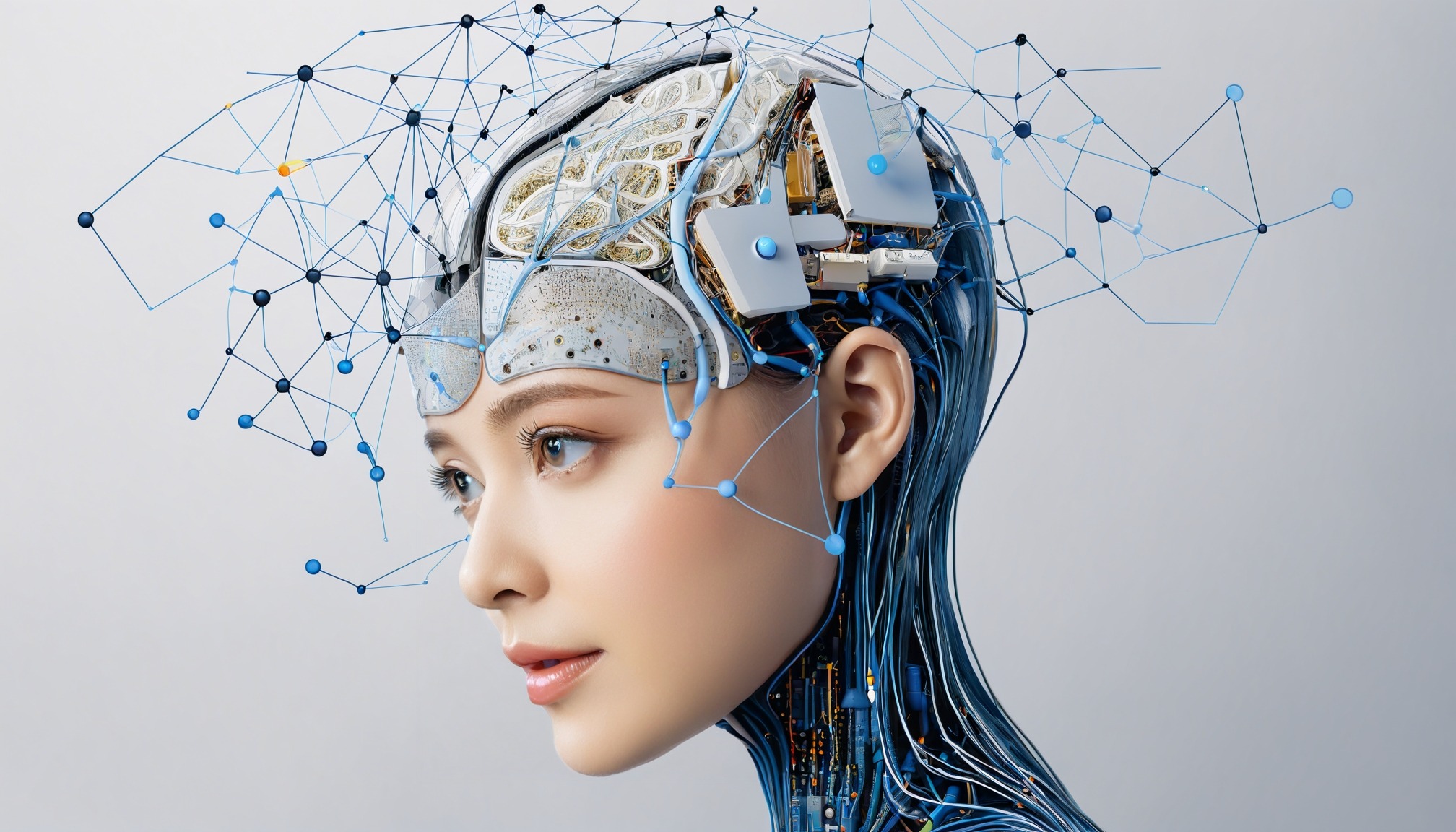
What is Deep Learning?
Deep learning is a subset of machine learning in artificial intelligence (AI) that uses algorithms inspired by the structure and function of the brain, called artificial neural networks. It is particularly powerful because of its ability to process vast amounts of data and its capability to identify complex patterns and relationships within that data. This approach has revolutionized many fields, from computer vision and natural language processing to healthcare and autonomous driving.
Core Concepts
Neural Networks: Deep learning models are built using layers of artificial neurons, or nodes, that mimic the human brain. These layers include an input layer, one or more hidden layers, and an output layer. Each neuron in a layer is connected to neurons in the subsequent layer, and these connections have associated weights that are adjusted during the training process.
Layers: The term “deep” in deep learning refers to the use of multiple hidden layers in the neural network. Each layer extracts features from the input data, with deeper layers capturing increasingly abstract representations. For example, in image recognition, initial layers might detect edges, while deeper layers might recognize shapes and objects.
Training: Training a deep learning model involves feeding it large amounts of labeled data and adjusting the weights of the connections to minimize the error in its predictions. This is done using a process called backpropagation, combined with an optimization algorithm such as stochastic gradient descent. The model iteratively learns to make more accurate predictions by adjusting the weights to reduce the difference between the predicted and actual outputs.
Applications
Computer Vision: One of the most significant achievements of deep learning is in the field of computer vision. Convolutional neural networks (CNNs) are a type of deep learning model specifically designed for processing grid-like data, such as images. CNNs have been used to achieve human-level performance in image classification tasks, object detection, and facial recognition.
Natural Language Processing (NLP): Deep learning has also made substantial strides in natural language processing. Recurrent neural networks (RNNs), and more recently, transformers, are deep learning architectures used to model sequential data. These models excel in tasks such as machine translation, text generation, sentiment analysis, and speech recognition.
Healthcare: In healthcare, deep learning is used for diagnosing diseases from medical images, predicting patient outcomes, and personalizing treatment plans. For example, deep learning models can analyze radiology images to detect tumors with accuracy comparable to, or even exceeding, human radiologists.
Autonomous Vehicles: Deep learning is a critical component of the technology stack in autonomous vehicles. It is used for object detection, lane detection, and decision-making processes that enable a vehicle to navigate safely and efficiently.
Advancements and Techniques
Transfer Learning: Transfer learning is a technique where a pre-trained model, initially trained on a large dataset, is fine-tuned on a smaller, specific dataset. This approach significantly reduces the time and computational resources required to train deep learning models and improves performance, especially when data is scarce.
Generative Adversarial Networks (GANs): GANs are a class of deep learning models that consist of two neural networks, a generator and a discriminator, that are trained simultaneously. The generator creates synthetic data, while the discriminator evaluates its authenticity. GANs have been used to generate realistic images, videos, and even music.
Reinforcement Learning: Deep reinforcement learning combines deep learning with reinforcement learning principles. It involves training models to make a sequence of decisions by rewarding them for desired actions. This technique has been used to achieve superhuman performance in games like Go and Dota 2.
Challenges and Future Directions
Despite its successes, deep learning faces several challenges. These include the need for large amounts of labeled data, significant computational resources, and difficulties in interpreting and explaining model decisions. Additionally, deep learning models are susceptible to adversarial attacks, where small changes to input data can lead to incorrect predictions.
Future research in deep learning is focused on addressing these challenges. Efforts are underway to develop models that require less data, are more computationally efficient, and are robust to adversarial attacks. Explainable AI is another critical area, aiming to make deep learning models more transparent and understandable to humans.
In conclusion, deep learning is a transformative technology with a wide range of applications. Its ability to learn from data and make accurate predictions has made it a cornerstone of modern AI research and development. As the field continues to evolve, deep learning is expected to drive further advancements and innovations across various industries.